Part 1: Background, beef sire & dairy female selection
This project was supported by Agriculture and Food Research Initiative Competitive Grant no. 2021-68008-34110 from the USDA National Institute of Food and Agriculture.
A beef x dairy genetics survey was conducted in 2018, which led to additional research in 2021 when Extension Educators and specialists surveyed 40 Wisconsin dairy farms utilizing beef x dairy genetics. In addition to sire selection, the 2021 survey included newborn calf care and milk-feeding practices. This article highlights some of the calf management results, with greater detail available in the corresponding white paper. Both the 2018 and 2021 white papers are available for download.
Part 2 of this series highlights the survey findings regarding calf care and marketing.
General farm information
Efforts were made to survey a range of herd sizes representative of the diversity of dairy farm sizes in
Wisconsin. The average lactating herd size was 735 cows, varying from 19 cows up to 7,414
cows. Participating farms represented milk production typically seen in Wisconsin. The average daily milk
production per cow was 85 pounds, ranging from 47 to 108 pounds per cow.
The average number of dairy heifer calves born per year was 317 and ranged from 0 to 2,387. The average number of beef x dairy crossbred calves born per year was 454, with a low of 1 and a high of 6,200 calves. While the number of calves born per year is relative to an individual farm’s lactating herd size, it is still worth noting. These data show there are dairy farms producing large numbers of beef x dairy crossbred calves. The potential exists for cattle growers to source significant numbers of beef x dairy crossbred calves from Wisconsin dairy farms.
How farms are using beef semen
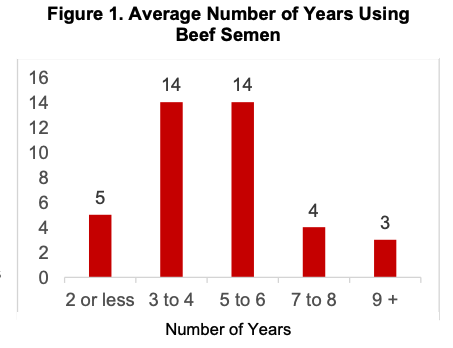
Farms were asked how many years they had been using beef sires in their herds. The average was 5 years, with a minimum of 2 years and a high of 20 years (Figure 1). The majority of farms, 70%, had between three and six years of experience using beef sires.
Participants were asked to identify the criteria they used to select which dairy cows and heifers are bred to beef sires. Farms could select more than one response. Artificial insemination (AI) service number was most frequently selected, with 29 of 33 responding farms identifying that as a key criterion. Next, parent average predicted transmitting ability (PTA) was selected by 21 farms, followed by lactation number by 17 farms, and genomic PTA by 16 farms.
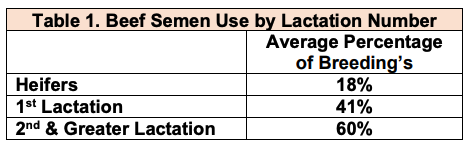
While farms demonstrated using several different criteria for deciding which females are bred to beef, AI service number and lactation number were recurrent themes. The survey asked the number of times cows and heifers received AI before switching to beef sires. Responses averaged 2.9 services for heifers, and 2.3 services for cows. Farms reported the percentage of heifers, first lactation cows, and second and greater lactation cows bred by semen type used: conventional dairy, sexed dairy, and beef. Beef semen was more likely to be used in later lactations as compared to first-lactation cows and virgin heifers (Table 1).
How farms are selecting beef sires
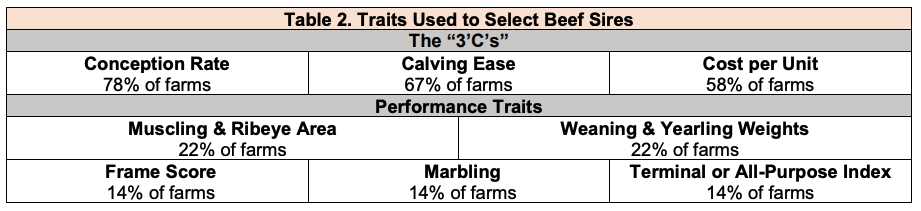
Participants were asked to rank, in order of importance, the beef sire selection traits used on their farms an
could rank more than one criterion. The “3 C’s” were the leading selection traits: conception rate, calving ease,
and cost per unit of semen (Table 2). While performance traits were also identified, they lagged behind the “3
C’s.” For performance traits, muscling and ribeye area, and weaning and yearling weights tied for the highest
ranking. These results indicate opportunities still exist for cattle growers and processors to reward dairy
producers to place a greater selection emphasis on feedlot performance and carcass traits.
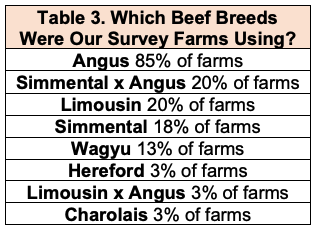
Farms shared which beef breeds they were using and could select more than one breed. Eight different breeds were reported (Table 3). Half of our survey farms reported using one beef breed, and half reported using multiples beef breeds. Angus was the most commonly used breed, followed by Simmental x Angus, Limousin, and Simmental.
The survey also analyzed the percentage of each breed used within farm (not overall use in the population). Angus and Simmental x Angus had the greatest average percent use within farm, 72% and 83% of breedings. While Wagyu was reported to be used by several farms, the percentage of breedings tended to be fewer amongst our survey farms, averaging 7% of breedings within farm.