Introduction
Direct marketing offers a way for livestock producers to control the value of their livestock. By cutting out parts of the supply chain – distributors, marketers – they may earn a larger share of the total selling price. It should be said that by cutting out these supply chain pieces, they are also taking on those roles themselves. Extra time and effort put into developing distribution and finding customers will decrease the amount of time livestock producers have to care for their animals. Here are some tips for getting started in direct marketing meat.
Licenses Needed
Depending on how and what kind of meat you sell, you may need obtain certain licenses. If selling a live animal to the customer(s), you do not need a license. If you are selling meat as a product, you will need a license. Depending on your situation, you may need to register as a meat distributor and/or obtain a Retail Food Establishment License. Administrative Code ATCP 75 highlights food safety regulations for retail food establishments. For more information on the needs of your operation, please contact the Department of Agriculture, Trade, and Consumer Protection (DATCP) Meat Licensing at (608) 224-4694 or visit their website ↗️. Lastly, be sure to check out additonal local/county laws prior to selling meat in your area.
Inspection of Meat Products
To ensure it’s safe, wholesome, and correctly labeled, all meat sold commercially must be inspected and passed under the Federal Meat Inspection Act (FMIA). Understanding levels of meat processing can be complex, but for direct marketers, there are three to be aware of: Federal, State, and Custom-Exempt.
Federally Inspected Processers: Meat processed at federally inspected facilities can be shipped over state lines and internationally to many countries. The United States Department of Agriculture’s Food Safety and Inspection Service (USDA FSIS) is responsible for this level of inspection. Some of the regulations required for this type of inspection include Hazard Analysis Critical Control Points (HACCP) plans, Sanitation Standard Operation Procedures (SSOPs), and daily inspection of processing facilities. If the plant slaughters livestock, before death (antemortem) and after death (postmortem) inspections are performed on every animal.
State Inspected Processors: Meat processed at state inspected facilities cannot be sold across state lines. Exceptions can be made if the state and the plant both complete the Cooperative Interstate Shipment program. The regulatory rigor of state-inspected meat processors must be equal to, or more rigorous than, federal inspection standards. Note that state meat inspection programs are not available in every state. Wisconsin is one of 27 states in the U.S. that offer this program.
Custom-Exempt Processors: Animals and meat processed at custom-exempt facilities can only be used by the animal owner(s) and must be labeled ‘Not for Sale’. The regulatory rigor is not as stringent as federal and state inspections; however, these plants are still subject to periodic, risk-based inspections by USDA FSIS and/or state authorities. If you want to sell meat to friends, family members, or other consumers, this level of processing is NOT enough.
| Federal Meat Processors | Wisconsin Meat Processors | Custom-exempt Meat Processors | |
|---|---|---|---|
| Meat processed can be shipped over state lines | ✅ Yes |
❌ No |
❌ No |
| Meat processed can be sold to consumers | ✅ Yes |
✅ Yes |
❌ No |
| Subject to rules and regulations set forth by USDA FSIS and/or DATCP | ✅ Yes |
✅ Yes |
✅ Yes |
For producers interested in selling meat direct-to-consumer, it is the producers’ responsibility to know the level of inspection they need and to choose a processor that has obtained the proper inspection level. For more information on inspection, please contact DATCP at (608) 224-4694 or visit their website ↗️.
What Should be on the Label?
At a minimum, the label must include the true name of the product, an ingredients statement, the net weight, and the name and address of the processor. Some processors are willing to print and place your own label specific to your products. Communicate with your processing location to see if that is an option for you. Proper labeling is important as there are legal consequences for making false label claims. If you think you may qualify for labels like “Certified”, “Organic”, or “No Hormones”, check out this USDA page ↗️. Administrative Code ATCP 55.10 highlights the rules for meat labels and formulas. For more information, check out the USDA Food Standards and Labeling Policy Book ↗️.
Where Should I Get My Animals Processed?
If producers intend to sell their meat products, they must get their animals processed at a locker plant that is state or federally inspected. Products will also have to follow WI law regarding licensing, registration, sanitation, and labeling. Information on meat establishments in Wisconsin can be found on the USDA website ↗️. This link includes custom exempt meat establishments, as well as federal and state-inspected meat establishments.
Establishing A Relationship with a Processor
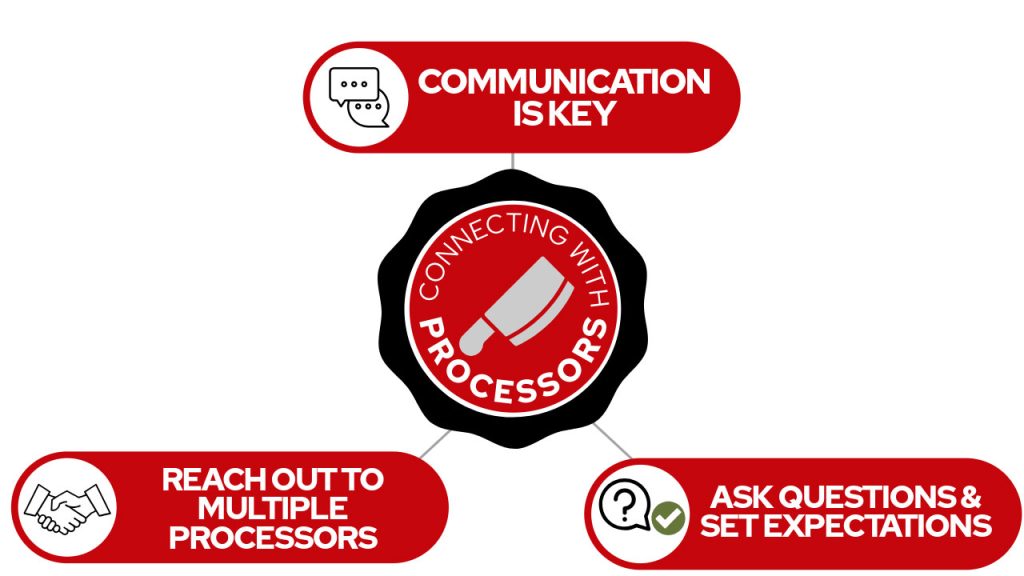
Establishing a relationship with a processor is a key component to becoming a successful direct marketer. Communication between the producer, processor, and customer is critical for a positive experience for all parties involved. It may be necessary to work with more than one processor to meet customer needs and desires.
Processors vary in their capacity for inspected harvest, cooler space, and fabrication time. Harvest dates may need to be scheduled well in advance, in most cases months, and maybe even years. Be sure to communicate with your processer about scheduling procedures that work best for them. Note that harvest dates around fair or hunting season may be slim. Establishing a positive relationship and clear communication with a processor will foster a positive working relationship for all parties.
Livestock producers can establish relationships with processors by stopping at or calling the facility. The two parties can discuss their own expectations for a livestock producer processor relationship. Items to discuss include harvest scheduling preferences, fabrication expectations, product labeling, and when meat products need to be picked up by the livestock producer or consumer.
Livestock producers should reach out to multiple processors to figure out which processor fits a producer’s preferences. This might mean livestock producers need to haul livestock to a processor that is a few towns away if the facility farther away can better meet the needs.
Establishing a Client Base
Relationship building is one of the most important aspects of establishing a client base for a direct marketing business. Relationships within your marketing region can be built through community events, online platforms, email, or word of mouth. Not every single individual in a community will be a purchaser of direct marketed livestock products, and that’s ok. A consumer’s purchasing decisions are influenced by a variety of factors, ranging from regional and cultural influences to financial capacity and specific preferences for how meat is cut, packaged, and cured. Other factors include whether you sell quarters, halves, whole animals, or individual cuts. Consumers may have to pay a larger upfront sum and need more freezer space. Direct marketed meat products can be more expensive than products from larger companies marketed in grocery stores, so it is important to know what your customers want and how much they are willing/able to pay for it.
Direct marketers should be innovative. Additional customers could be local grocery stores, restaurants, vending machines, etc. The options truly are endless. Always remember to check the rules and regulations for each avenue of direct marketing meat.
Authors

Adam Hartfiel
Regional Livestock Educator – Adam Hartfiel is Regional Livestock Educator for Adams, Green Lake, Waushara Counties. His educational programming has focused on beef cattle production and management.

Beth McIlquham
Beth McIlquham is a Regional Livestock Educator serving Crawford, La Crosse, Richland, and Vernon counties. She works alongside producers to provide livestock-related programming aligned with the needs of the area.
Published: January 28, 2026
Reviewed by:
- Bill Halfman, Beef Outreach Specialist at the University of Wisconsin–Madison Division of Extension
- Ryan Sterry, Regional Livestock Educator at the University of Wisconsin–Madison Division of Extension
- Jeff Swenson, Livestock and Meat Specialist at WI DATCP
References
- Food Safety and Inspection Service. (2023, June 9). Federal Meat Inspection Act. U.S. Department of Agriculture. https://www.fsis.usda.gov/policy/food-safety-acts/federal-meat-inspection-act
- Wisconsin Department of Agriculture, Trade and Consumer Protection. (n.d.). Meat and poultry businesses. Wisconsin Department of Agriculture, Trade and Consumer Protection.
- Wisconsin Department of Agriculture, Trade and Consumer Protection. (n.d.). Food licenses. Wisconsin Department of Agriculture, Trade and Consumer Protection. https://datcp.wi.gov/Pages/Licenses_Permits/FoodLicenses.aspx
- Food Safety and Inspection Service. (2025, September). Compliance guidelines for establishments on the FSIS microbiological sampling program for raw beef products. U.S. Department of Agriculture. https://www.fsis.usda.gov/guidelines/2005-0003
- Food Safety and Inspection Service. (2024, July 2). Meat and poultry labeling terms. U.S. Department of Agriculture. https://www.fsis.usda.gov/food-safety/safe-food-handling-and-preparation/food-safety-basics/meat-and-poultry-labeling-terms
- Food Safety and Inspection Service. (2026, January 5). Meat, poultry, and egg product inspection directory. U.S. Department of Agriculture. https://www.fsis.usda.gov/inspection/establishments/meat-poultry-and-egg-product-inspection-directory