
Skip to content

Livestock

Division of Extension

  • Topics
    • Meat
    • Beef
    • Beef x Dairy
    • Poultry
    • Swine
    • Small Ruminants
    • Decision Tools and Software
  • 🗓️ Livestock Events
    • Event Calendar
    • Driftless Region Beef Conference
    • Farm Ready Research
  • News
  • Programs
    • Beef Roundup Webinar Series
    • Master Meat Crafter Training Program
    • Small Ruminant Webinar Series
    • Wisconsin Youth Livestock
  • Articles
  • People
  • About
    • Our Impacts
  • Contact Us
Search
University of Wisconsin-Extension

Home » Articles

Share
  • Share:
  • Share on Facebook
  • Share on X (Twitter)
  • Share via Email
  • Copy Link

Copied!

Articles

  • Reset Topic Filter
Should you deworm your cattle this fall?

Should you deworm your cattle this fall?

Deworming decisions are farm-specific and depend on the age of the animal, how much exposure they had to infective larvae while grazing this spring and summer or the previous spring and summer, when they were last dewormed, and what products were used.

Options for feeding the beef cow herd when hay supplies are short

Options for feeding the beef cow herd when hay supplies are short

Management options that a spring-calving cow herd may consider to get through the winter feeding season when hay is in short supply. The examples given use general assumptions because options and costs vary from farm to farm and over time.

Biosecurity in the feedlot

Biosecurity in the feedlot

Bringing new calves to the feedlot is stressful for them due to transportation, adjusting to a new home, changing feed, exposure to disease, and establishing social order with new cattle. Minimizing both clinical and subclinical disease in feedlots is essential for producers to improve profitability.

Step into biosecurity with clean and disinfected boots

Step into biosecurity with clean and disinfected boots

Keeping your livestock safe from microbes, including bacteria, viruses, and fungi, is the biosecurity goal that all farms should have. Wearing clean, sanitized footwear helps meet this goal as foot traffic moves microbes to and around the farm.

Finely ground corn raises risk of acidosis in finishing rations

Finely ground corn raises risk of acidosis in finishing rations

Finishing rations in our part of the country are usually around 10% roughage, give or take, to get energy levels high enough to finish cattle that will meet packer expectations efficiently. Corn makes up much of the remainder of the ration, and this corn is most often coarsely rolled or cracked.

Corn silage opportunities and considerations for drought-stressed corn

Corn silage opportunities and considerations for drought-stressed corn

Beef cow-calf producers are feeling the pinch of low pasture and hay yields due to drought conditions across the state.  Corn silage is another feed source that can be used to help meet the herd’s nutritional needs.

Use the proper syringe and needle when vaccinating cattle

Use the proper syringe and needle when vaccinating cattle

Using the right equipment when vaccinating your cattle requires the right tools. The correct syringes and needles must be used in addition to a well-designed and functioning headgate to restrain cattle so injections may be safely administered in the neck area.

Easy in, easy out: Incorporate biosecurity upon the introduction of new animals

Easy in, easy out: Incorporate biosecurity upon the introduction of new animals

For decades, livestock producers have moved animals on and off the farm by way of sale, leasing, renting, and between other facilities or pastures owned by the farm. With these movements comes the risk of the introduction or spread of disease.

Are you ready to haul cattle?

Are you ready to haul cattle?

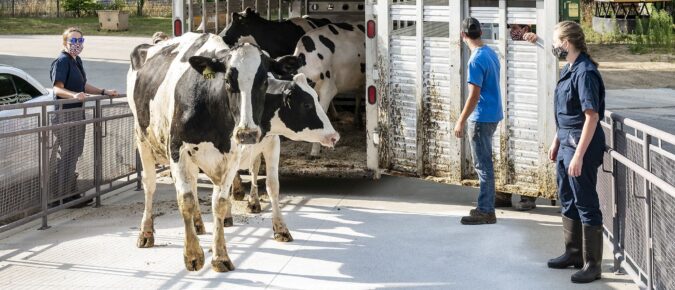
The frequency of hauling cattle varies from farm to farm. Some farms haul on a regular basis and others only a few times a year. In either situation, breaking down alongside the road — or even worse, in a traffic crash — while hauling cattle is not on anyone’s bucket list.

Methane emissions from livestock and climate change

Methane emissions from livestock and climate change

In the increasing discussions about how to address climate change there are conflicting claims about the need to address methane (CH4) emissions.  Some people argue that methane emitted by cows is a primary cause of climate change.  Others argue that methane from beef and dairy production is not of much concern because of its relatively short duration in the atmosphere.

Posts navigation

â—„ 1 … 6 7 8 9 10 … 22 â–ş

Division of Extension

Connecting people with the University of Wisconsin

  • Agriculture
  • Community Development
  • Health & Well-Being
  • Families & Finances
  • Natural Resources
  • Positive Youth Development

Agriculture at Extension

  • Animal Sciences
  • Crops and Soils
  • Dairy
  • Farm Management
  • Horticulture
  • Discovery Farms
  • Master Gardener
University of Wisconsin-Madison      |        Explore Extension: Agriculture Community Development Families & Finances Health Natural Resources Youth
Connect With Us
Support Extension
Extension Home

We teach, learn, lead and serve, connecting people with the University of Wisconsin, and engaging with them in transforming lives and communities.

Explore Extension »

County Offices

Connect with your County Extension Office »

Map of Wisconsin counties
Staff Directory

Find an Extension employee in our staff directory »

staff directory
Social Media

Get the latest news and updates on Extension's work around the state

facebook iconFacebook

twitter icon Follow on X


Facebook
Follow on X

Feedback, questions or accessibility issues: info@extension.wisc.edu | © 2026 The Board of Regents of the University of Wisconsin System
Privacy Policy | Non-Discrimination Statement & How to File a Complaint | Disability Accommodation Requests

The University of Wisconsin–Madison Division of Extension provides equal opportunities in employment and programming in compliance with state and federal law.