Skip to content
UW Madison Crest

Livestock

Division of Extension

  • Topics
    • Meat
    • Beef
    • Beef x Dairy
    • Poultry
    • Swine
    • Small Ruminants
    • Decision Tools and Software
  • 🗓️ Livestock Events
    • Event Calendar
    • Driftless Region Beef Conference
  • News
  • Programs
    • Beef Roundup Webinar Series
    • Master Meat Crafter Training Program
    • Parasite Patrol
    • School for Beginning Beef Production
    • Small Ruminant Webinar Series
    • Wisconsin Youth Livestock
  • Articles
  • People
  • About
    • Our Impacts
  • Contact Us
Search
University of Wisconsin-Extension

Fall 2026 Cattle Feeder Enterprise Projections Now Available

Written by Livestock Program Posted on October 21, 2026
Share
  • Share:
  • Share on Facebook
  • Share on X (Twitter)
  • Share via Email
  • Copy Link

Copied!

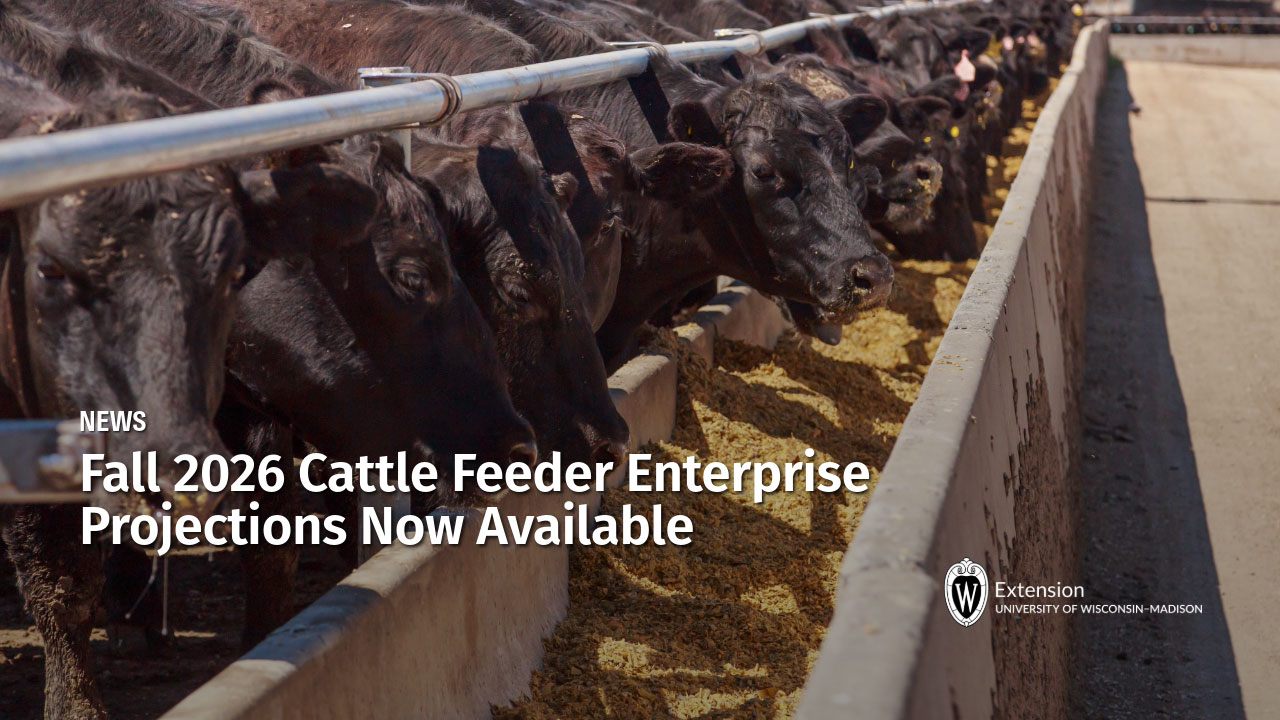
"Fall 2026 Cattle Feeder Enterprise Projections Now Available" article title with feedlot cattle eating from a bunk. UW-Madison Extension logo shown in the lower right corner.

High cattle prices and rising input costs coupled with volatility have forward-thinking cattle feeders and backgrounders doing some calculations to determine what they can pay for feeder calves, and/or what they should forward contract them for. To assist with this task UW-Madison Division of Extension has assembled a set of projections using price and cost estimates as of early October 2026. 

These projections are intended to serve as an initial guide. They are based on regional averages; therefore, producers are strongly encouraged to use their own numbers rather than these estimates to evaluate their specific situation. 

Download Fall 2026 Cattle Feeder Enterprise Projections examples

Projected sale prices were estimated by looking at futures contract prices and considering seasonal and cyclical trends in addition to current placements and animal breed influence on prices. Note that commodity prices change daily due to market volatility and could affect producer projections.

Download Fall 2026 Cattle Feeder Enterprise Projections

The projections suggest there is an opportunity for profit for some of the enterprises if cash prices follow what the futures market is predicting. However, market and input cost volatility can result in rapid changes in margins

We encourage producers to use the UW-Madison Extension Feedlot Enterprise Budget Tool (xls) to evaluate their own scenario.  It includes sections for determining ration, yardage and labor and management costs that the projections file does not. Using the enterprise budget tool or similar tools with your own numbers is more valuable to help you with your decisions.  The projections are intended to be an initial guide.

About Fall 2026 Cattle Feeder Enterprise Projections

The projections include the following nine different feedlot related enterprises that are summarized on the first tab of the file. Each enterprise projection has its own sheet within the file. 

  • Holstein bull calf birth to 400 lbs. 
  • Beef x dairy cross calf birth to 400 lbs. 
  • Beef x dairy cross steers 400 to 1550 lbs. 
  • Beef x dairy cross heifers 400 to 1450 lbs. 
  • Holstein steers 400 to 800 lbs. 
  • Holstein steers 400 to 1550 lbs. 
  • Holstein steers 800 to 1550 lbs. 
  • Beef feeder steer calves finish 550 to 1500 lbs. 
  • Beef heeder heifers 500 to 1400 lbs. 
  • Beef feeder calves- background 500 to 900 lbs. 
  • Beef steer yearlings to finish 800 to 1500 lbs.  
  • Add condition to thin cull beef cows 1200 to 1400 lbs. 

Summary

With high cattle prices, proactive cattle feeders and backgrounders are calculating the costs and potential returns for feeder calves. To aid in this, UW-Madison Division of Extension has provided example projection estimates.  Producers should use their own numbers to best evaluate their situation.  


UW-Madison Extension
Livestock Program News
Beef Roundup Webinar Series Returns for Third Year

Beef Roundup Webinar Series Returns for Third Year

Learning Leads to Action: Real Profitability Gains for Local Beef Producers

Learning Leads to Action: Real Profitability Gains for Local Beef Producers

Highlights from Wisconsin Beef Cattle Feeders Twilight Meeting

Highlights from Wisconsin Beef Cattle Feeders Twilight Meeting

Read more News

Subscribe to our Livestock Newsletter

A single hand holds up a smart phone with an email icon floating above it representing email notifications. "Livestock Newsletter" is written in block letters to the left.

Subscribe to the Livestock Program Newsletter to receive the latest Livestock research articles and information about upcoming Livestock events!

Read our most recent Livestock Newsletter here ↗️


Related

Livestock Decision Tools and Software

Categorized: Beef

Division of Extension

Connecting people with the University of Wisconsin

  • Agriculture
  • Community Development
  • Health & Well-Being
  • Families & Finances
  • Natural Resources
  • Positive Youth Development

Agriculture at Extension

  • Ag Water Quality
  • Crops and Soils
  • Dairy
  • Farm Management
  • Horticulture
  • Livestock
University of Wisconsin-Madison      |        Explore Extension: Agriculture Community Development Families & Finances Health Natural Resources Youth
Connect With Us
Support Extension
Extension Home

We teach, learn, lead and serve, connecting people with the University of Wisconsin, and engaging with them in transforming lives and communities.

Explore Extension »

County Offices

Connect with your County Extension Office »

Map of Wisconsin counties
Staff Directory

Find an Extension employee in our staff directory »

staff directory
Social Media

Get the latest news and updates on Extension's work around the state

facebook iconFacebook

twitter icon Follow on X


Facebook
Follow on X

Feedback, questions or accessibility issues: info@extension.wisc.edu | © 2026 The Board of Regents of the University of Wisconsin System
Privacy Policy | Non-Discrimination Statement & How to File a Complaint | Disability Accommodation Requests

The University of Wisconsin–Madison Division of Extension provides equal opportunities in employment and programming in compliance with state and federal law.