At a Glance
To reduce the impacts of heat stress in beef cattle, optimize herd hydration, maximize air ventilation or shade, and postpone handling or transport during peak heat. Monitor heat stress by counting respiration: cattle breathing rates between 90–110 breaths per minute (bpm) signal an alert stage, while rates exceeding 130 bpm indicate a critical livestock emergency.
Key Takeaways
Massive clusters of up to thousands of ticks per animal cause severe blood loss (exsanguination), dropped milk production, and stunted growth. Transmission of the Theileria parasite destroys red blood cells, triggering severe lethargy, labored breathing, jaundice, fever, and late-term abortions. Surviving cattle become lifelong carriers.
- Diagnose Heat Stress Levels: Track physiological stress by counting breaths per minute. A rate of 90–110 bpm indicates an Alert status, 110–130 bpm signifies Danger, and any rate over 130 bpm demands Emergency intervention.
- Optimize Infrastructure (Water & Airflow): Clean existing waterers and place additional high-capacity tanks in pastures to meet increased hydration demands. Maximize indoor airflow using fans or positive pressure tubes to eliminate dead air spaces, and provide shade structures that prevent tight herd bunching.
- Modify Management Timelines: Postpone non-essential transport, handling, or processing. If processing is mandatory, restrict activities to early morning hours using low-stress techniques. Cool pens by wetting down mounds in the early morning so cattle can dissipate heat in the evening; avoid fine mists, which inadvertently raise humidity.
Introduction
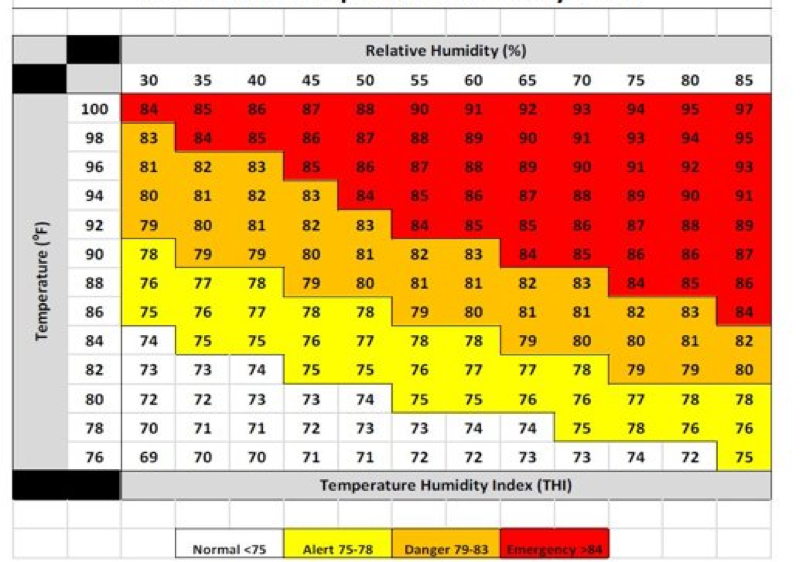
There is no question that heat stress can negatively impact animal performance. For feedlot cattle heat stress reduces daily gains, negatively impacts feed efficiency and can lower dressing percent. Cow-calf producers could expect greater embryonic loss in the first few weeks after conception due to heat stress. High temperatures could also impact semen quality in bulls 2 to 4 weeks after the heat stress event, resulting in lower conception rates. Prolonged exposure to heat stress is much more detrimental than short-term heat stress and its effects linger long after temperatures drop back below the heat stress threshold. The following chart shows the level of heat stress on beef cattle at different temperature and humidity levels.
How to Measure Cattle Heat Stress Using Breathing Rates
To evaluate cattle heat stress, count their breathing rate. Since cattle do not sweat, they try to dissipate heat by increasing their breathing rate. The following chart shows the level of heat stress based on breathing rate.
| Predicted Breathing Rate (breaths per minute) | Heat Stress Category |
|---|---|
| Less than 90 | Normal |
| 90-110 | Alert |
| 110-130 | Danger |
| Greater than 130 | Emergency |
Best Management Practices to Reduce Livestock Heat Stress
Follow these management practices to help reduce cattle heat stress.
Provide adequate ventilation
If cattle are being fed and housed in an enclosed barn or building, use fans to move air out and through the building; open sides of the barn to improve airflow, or provide access to an outside pen or pasture with shade. Using sprinklers in this situation will potentially intensify the problem and create more humidity without proper air movement to remove it from the building. Keep in mind that some sheds may have dead air spaces in them, for example in the back, below the knee wall where cattle may lay down. Fans and positive pressure tubes can help correct these problems.
Avoid handling, transporting, moving, or processing cattle
If these activities must occur during this time, they should be done early in the morning hours while using low-stress handling techniques, but it is best to delay them until better weather when possible.
Provide plenty of water
Make sure the water supply to cattle is able to meet the increased demands during hot weather. Also, make sure the waterers are clean to not discourage intake. It may be necessary to provide additional tanks especially if cattle only have access to one tank in the pastures.
Provide shade
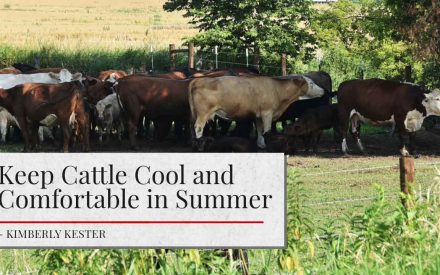
Shade is critical, especially for dark-haired cattle and/or fleshy cattle, therefore providing a pasture with access to trees or open buildings. Portable shade options are also a possibility. In open feedlots or pastures without shade, please see Tip 4 to reduce heat stress. It is also a good idea to provide shade in such a manner to prevent bunching up which reduces good airflow and often causes a mud hole under the shade.
Sprinkle cattle and pen with water
As evening approaches cattle try to dissipate heat, so spraying water on mounds or pens where cattle can lie down will help. Also avoid spraying cattle with a mist, because in high humidity this may only contribute to instead of alleviating the problem of heat stress. Be careful and first introduce the water to cattle in early morning hours and or ahead of time so they are accustomed to being wetted down to avoid adding additional stress to the cattle when spraying them with water.
Cattle Heat Stress Prediction Maps and Resources
For more details, including heat stress prediction maps, are available online from the USDA ARS U.S. Meat Animal Research Center website ↗️.
References
- Brown-Brandl, T. M., Eigenberg, R. A., Nienaber, J. A., and Hahn, G. L. 2005. Dynamic response indicators
of heat stress in shaded and non-shaded feedlot cattle, Part 1: Analyses of indicators. Biosystems Engineering 90(4): 451-462. - Lily N Edwards-Callaway, M Caitlin Cramer, Caitlin N Cadaret, Elizabeth J Bigler, Terry E Engle, John J Wagner, Daniel L Clark, Impacts of shade on cattle well-being in the beef supply chain, Journal of Animal Science, Volume 99, Issue 2, February 2021, skaa375, https://doi.org/10.1093/jas/skaa375
- Mader, T. L., Davis, M. S., and Brown-Brandl, T. M. 2006. Environmental factors influencing heat stress in feedlot cattle. J. Anim. Sci. 84: 712-719.
Originally Published: June 2022
This article originally appeared in the Wisconsin Cattlemen’s Cattle Trails newsletter.
Author
- Bill Halfman – Beef Outreach Specialist, University of Wisconsin-Madison Division of Extension