
Table of Contents
Introduction
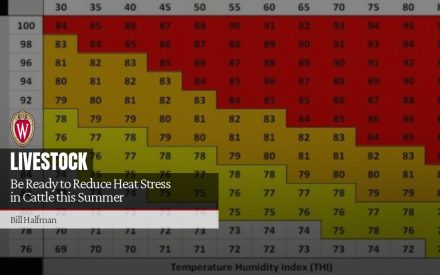
The latest long-range forecasts from the National Weather Service show that Wisconsin has a 40% to 50% chance of a hotter-than-normal summer. Long periods of heat stress are more likely to have lasting effects on cattle, including early embryonic loss in heifers and cows, poor semen quality in bulls, and reduced gains in feeder cattle.
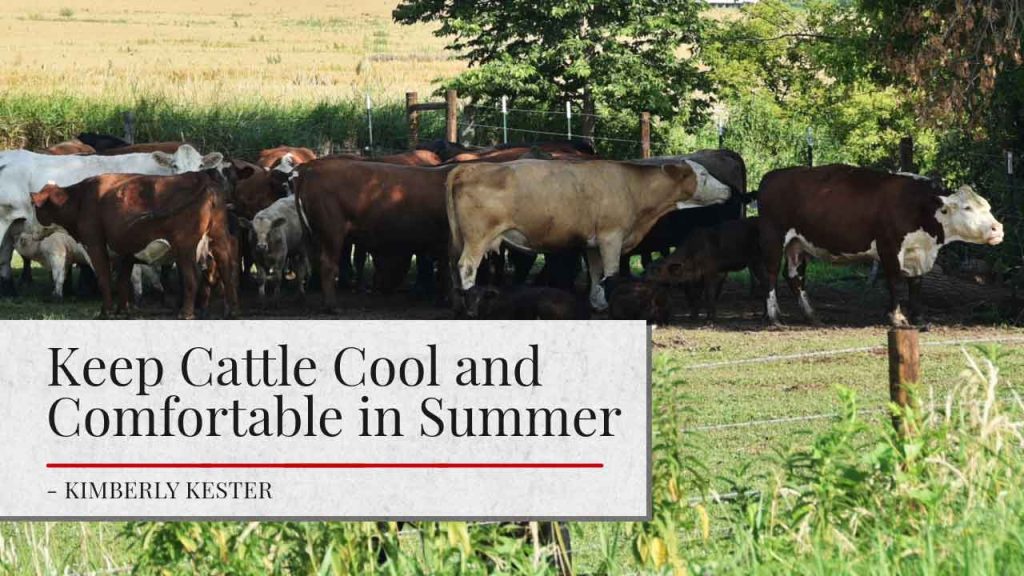
Cattle have a comfort zone of 32 to 77 degrees F. When temperatures rise above this range, cattle use valuable energy to stay cool. Environmental factors contribute to heat stress in cattle, including ambient temperature, humidity, wind speed, and solar radiation.
Watch for signs of stress
Measuring breathing rate is the simplest way to evaluate an animal’s current level of heat stress. Set a timer for 60 seconds and count how many breaths per minute (BPM) the animal takes:
- less than 90 BPM — normal
- 90 to 110 BPM — closely monitor
- over 110 BPM — in distress
- over 130 BPM — intervene now
Other signs of heat stress include spending more time standing, restlessness, and drooling. In extreme cases, cattle may open-mouth breathe, and breathing appears labored. Young calves and heavy cattle are more sensitive to heat and have a greater risk of heat stress.
Beat the heat
Shade structures or trees provide areas where the temperature is lower, plus less solar radiation reaches cattle. Cloud cover also reduces solar radiation. Cattle on pasture with no shade experience higher temperatures and more intense solar radiation, which increases their risk of heat stress. Beef cows should have access to about 30 square feet of shade per head. If there is not enough shade area, animals may congregate under the limited shade and reduce their ability to dissipate heat.
Drinking water helps animals regulate their body temperature. Ensure they have fresh, clean water that is easily accessible. On an 80-degree day, a 500-pound growing calf needs roughly 8 gallons of water per day, and a lactating cow needs up to 18 gallons. Water can also be used to spray down mounds or the ground where cattle bed down in the evening. Cooling the ground temperature will help cattle stay comfortable as they rest for the night.
Air movement is critical to reducing cattle body temperatures. If cattle are fed or housed in a shed or barn, consider using fans to move air across the herd. Leave overhead doors open to increase airflow. Cattle on pasture can dissipate additional heat if there is a breeze or if they can access hills. Feedlot animals with outside lot access can spread themselves out and have better airflow with access to earthen mounds.
Avoid feeding during the hottest parts of the day, because body temperatures increase as feed is digested.
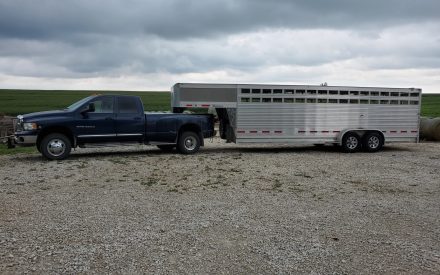
Also avoid herd health events or shipment during periods of extreme heat. Many handling facilities do not allow for adequate airflow while cattle are being held. If handling must occur, plan it for early morning or late evening when temperatures are lower. If you must haul cattle, minimize stops to ensure air circulates through the trailer while you drive as much as possible.
Monitoring your herd’s behavior, providing access to shade and water, and making minor changes to management strategies can reduce the risk of heat stress in cattle. This will have a positive impact on animal welfare and your bottom line.
References
Ahlberg, C.M., Allwardt, K., Broocks, A., Bruno, K., McPhillips, L., Taylor, A., Krehbiel, C.R., Calvo-Lorenzo, M.S., Richards, C.J., Place, S.E., DeSilva, U., VanOverbeke, D.L., Mateescu, R.G., Kuehn, L.A., Weaber, R.L., Bormann, J.M., & Rolf, M.M. (2018). Environmental effects on water intake and water intake prediction in growing beef cattle. Journal of Animal Science, 96(10), 4368–4384. https://doi.org/10.1093/jas/sky267
Edwards-Callaway, L.N., Cramer, M.C., Cadaret, C.N., Bigler, E.J., Engle, T.E., Wagner, J.J., & Clark, D.L. (2021). Impacts of shade on cattle well-being in the beef supply chain. Journal of Animal Science, 99(2), 1-21. https://doi.org/10.1093/jas/skaa375
Idris, M., Uddin, J., Sullivan, M., McNeill, D.M., Phillips, C.J.C. (2021). Non-invasive physiological indicators of heat stress in cattle. Animals, 11(1), 71. https://doi.org/10.3390/ani11010071
National Academies of Sciences, Engineering, and Medicine. (2016). Nutrient requirements of beef cattle: Eighth revised edition. Washington, DC: The National Academies Press. https://doi.org/10.17226/19014
NOAA National Weather Service. (2024). Three-month outlooks: Official forecasts. Climate Prediction Center. https://www.cpc.ncep.noaa.gov/products/predictions/long_range
Reviewer
Bill Halfman
Beef Outreach Specialist
UW-Madison Extension
Author

Kimberly Kester
Dairy and Livestock Program Manager – Kimberly’s programming focuses on beef cow-calf operations, specifically genetic improvement, heifer development, and heat abatement. She also supports programming in small ruminant parasite management and poultry flock management.