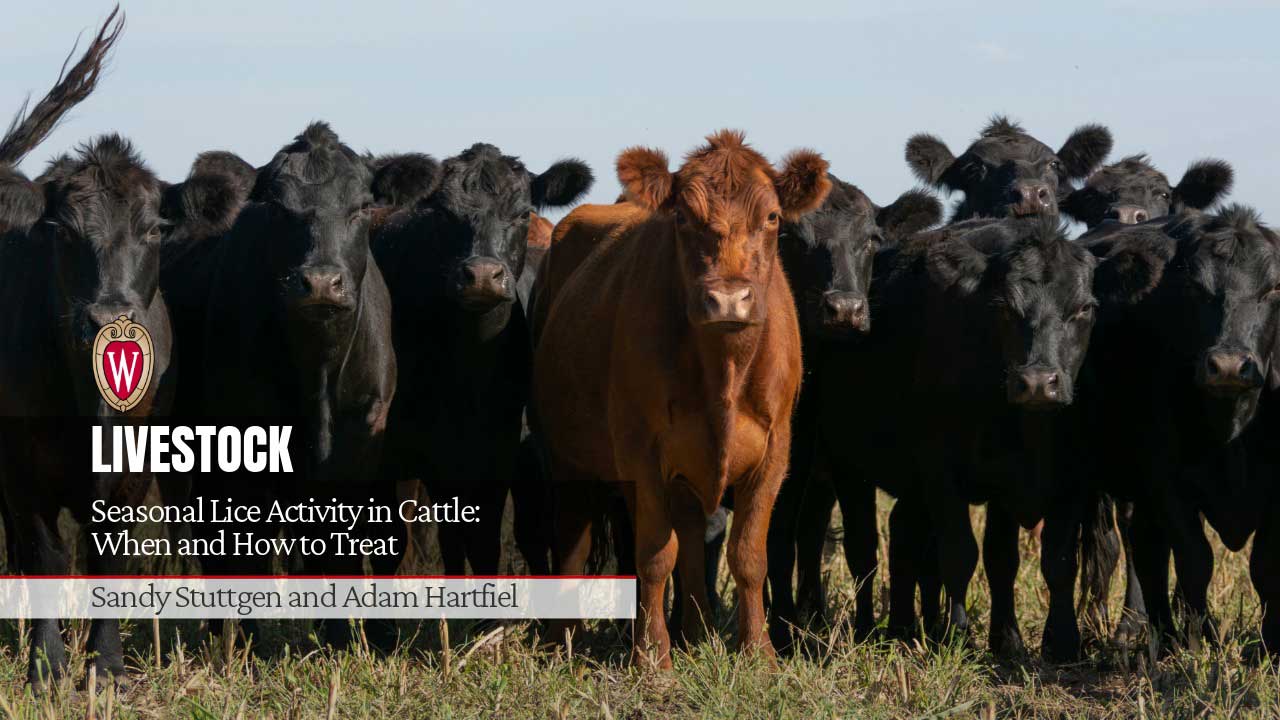
Cattle lice are commonly seen during Wisconsin’s winter. Treating lice costs money, time, and labor—and resistance to common products is increasing. Before you reach for treatment, ask yourself: Do my cattle actually need delousing, and when is the best time to treat them? Once you decide to treat, do so correctly to reduce insecticide resistance in your herd.
Cattle support lice year-round. Lice activity increases in winter because thick hair coats and the warm, humid layer near the skin create ideal conditions for them. Additionally, over-crowding, poor animal husbandry, and feed quality can contribute to increased severity of lice infestations. As spring arrives, cattle shed hair—and many lice with it. In summer, thin hair coats and direct sunlight reduce lice activity. UW Madison Division of Extension’s Lice Management for Cattle summarizes their life cycle.
To decide whether treatment is needed, closely inspect a few animals. Cut a one-by one-inch square of cardboard for a guide and use a 1–10 scale to estimate the number of lice per square inch on the head, neck, shoulders, back, rump, and tail switch while cattle are safely restrained. University of Nebraska-Lincoln articles, Fall Cattle Lice Treatments ↗️ and Prepare for Cattle Lice ↗️, and their video, Cattle Lice Treatment and Control ↗️ include lice-counting directions.
If you find more than 10 lice per square inch, treat the animal right away. At this level, cattle are usually itchy and may already be losing hair. Because lice spread quickly through direct contact and shared surfaces or equipment, treat the whole herd when treatment is warranted. Lice survive only a few days off the host; therefore, deep cleaning the environment is unnecessary.
Avoid treating too early, producers who pair delousing treatments in fall or early winter with other fall management tasks like weaning need to monitor the effectiveness of treatments. If your herd has a history of lice, a late‑fall or early‑winter treatment can help—but only if hair coats have grown in and temperatures are consistently cold. Most products don’t kill eggs, and their residual activity may wear off before the next hatch. Treating too early in a warm fall or using a product that has too short of a residual activity often leads to disappointment.
A variety of lice control products are available. The COWS Technical Manual ↗️ provides help with product selection. Most insecticides used for lice control are pyrethroid pour‑ons or powders, but each product has its own strengths. Read the label carefully for dosage, residual activity, and withdrawal times. Rotate active ingredients to slow lice resistance and increase long term effectiveness.
The type of lice on your cattle also matters. Read the label of systemic products, such as macrocyclic lactones like the Cydectin® or Eprinex®; some work better on sucking lice, while others target biting lice more effectively. Many non‑systemic products don’t kill eggs, so you may need a second application about 14 days after the first to target new nymph and adult stages. Keeping in mind the average two- to five-week louse life cycle and only nymphs and adults are hindered by the treatment, recheck animals at two-week intervals for two months after treatment to make sure the treatment worked to reduce the lice infestation.
Eradicating them is difficult and often unnecessary. Cattle and lice can co-exist when lice don’t get the upper hand. Closely observe your cattle during the winter and quickly (and effectively) treat to reduce production losses for your cattle.
Authors

Sandy Stuttgen
County Livestock Educator – Sandy is an associate professor with UW Division of Extension and serves as the agriculture educator for Taylor County. Her focus areas include cattle well-being and quality assurance programming, farm financial risk management, and farm succession.

Adam Hartfiel
Regional Livestock Educator – Adam Hartfiel is Regional Livestock Educator for Adams, Green Lake, Waushara Counties. His educational programming has focused on beef cattle production and management.
Published: April 15, 2026
Reviewed by:
- Sandy Stuttgen, County Livestock Educator at the University of Wisconsin–Madison Division of Extension Taylor County
- Heather Schlesser, County Dairy Educator at the University of Wisconsin–Madison Division of Extension Marathon County
References
- Boxler, D. (2023, October 1). Fall cattle lice treatments. University of Nebraska–Lincoln BeefWatch. https://beef.unl.edu/beefwatch/2023/fall-cattle-lice-treatments/
- Boxler, D. (2025, December 1). Prepare for cattle lice. University of Nebraska–Lincoln Beef. https://beef.unl.edu/prepare-cattle-lice/
- COWS Control of Ectoparasites and Insect Pests of Cattle. COWS Technical Manual. 2024. Available online: www.cattleparasites.org.uk
- Holdsworth, P. A., Vercruysse, J., Rehbein, S., Peter, R. J., Letonja, T., & Green, P. (2006). World Association for the Advancement of Veterinary Parasitology (W.A.A.V.P.) guidelines for evaluating the efficacy of ectoparasiticides against biting lice, sucking lice and sheep keds on ruminants. Veterinary Parasitology, 136(1), 45–58. doi:10.1016/j.vetpar.2005.11.008
- Maurizio, A.; Frangipane di Regalbono, A.; Cassini, R. Quantitative Monitoring of Selected Groups of Parasites in Domestic Ruminants: a Comparative Review. Pathogens. (2021). 10, 1173. https://doi.org/10.3390/pathogens10091173.
- UNL BeefWatch. (2021). Cattle lice treatment and control [Video]. YouTube. https://www.youtube.com/watch?v=_FPddBwOuuw
- Wall, R. Ectoparasites: Future challenges in a changing world. Vet. Parasitol. 2007, 148, 62–74.